


The usual suspects
We believe the current narrative around bond yields is driven by three factors: government deficits, the competition for capital for the AI capex cycle, and rising energy costs.
Government deficits
The argument is governments ‘compete for capital’ to fund ongoing deficits. This ‘crowding’ of the capital markets drives up the price of money and hence bond yields.
As we have highlighted on many occasions over the 13 years of our white papers, budget deficits alone do not drive up bond yields. Empirically, and logically, deficits provide the funds to buy the bonds. For example, in order to buy Australian government bonds, one must first have Australian dollars. And where do those dollars come from? In large part, Australian deficit spending.
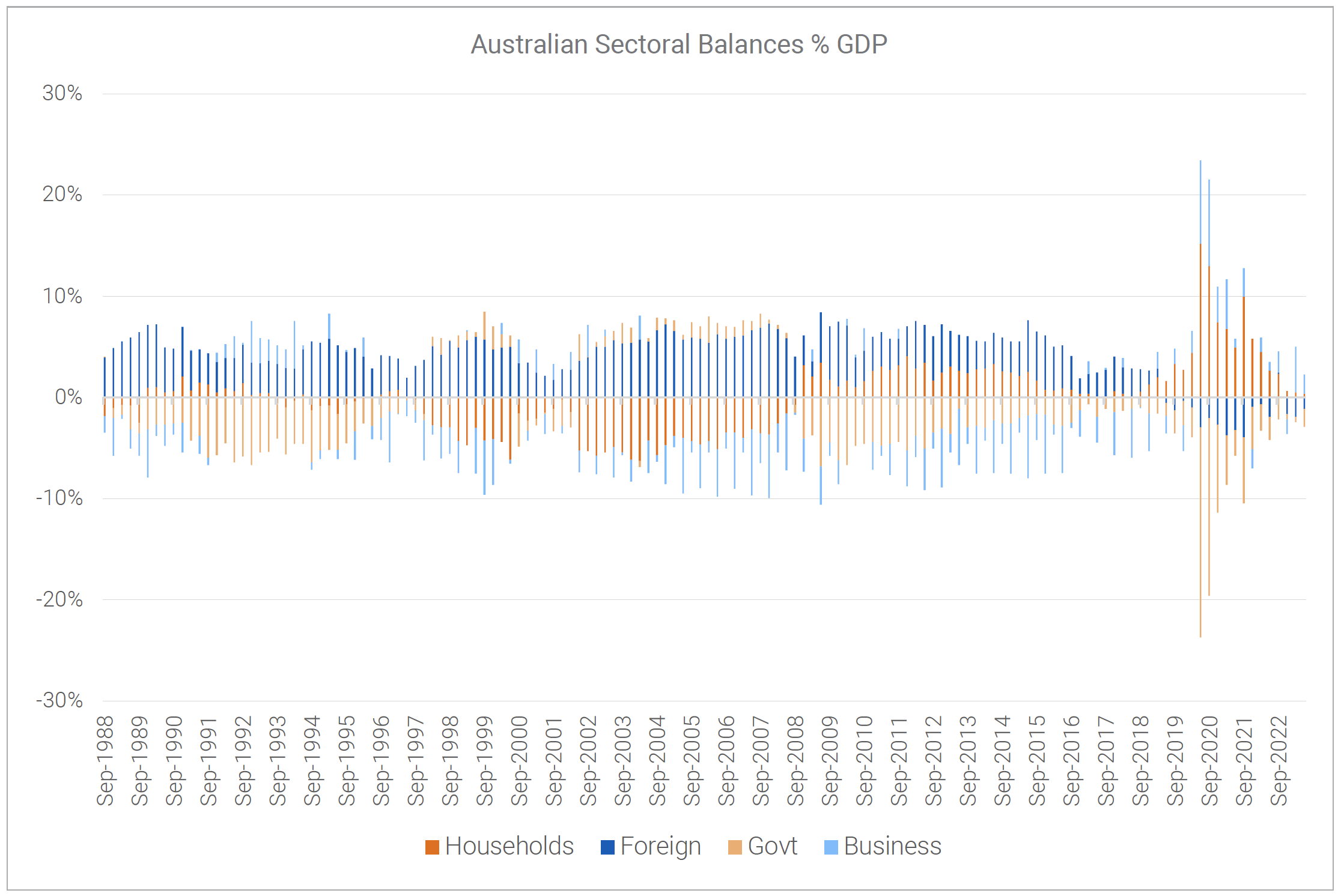
The sectoral balances below tell the story. Deficits flood the non-government sector with money (and savings) and that money is available for the purchase of bonds by the non-government sector.
 Source: ABS, Quay Global
But what if the private sector decides to invest savings in something other than bonds? Like a house, or shares, Bitcoin, or art?
The answer is the stock of savings from the deficit never disappears by private sector transactions. If one was to buy shares, the seller now has the cash. Same for any existing asset. Moreover, if one was to invest in a new IPO or company, that cash ends up in the company accounts, then when that is spent, back into the employees’ or service providers’ accounts.
The only way cash financial savings can disappear from the non-government sector is if they are taxed or used to acquire non-private sector assets (ie government bonds). Of course, very few people buy bonds individually. They are generally bought by the custodian of our financial savings (banks, large investment companies etc). The purchase of the bonds absorbs the extra cash from the deficit spending.
This all means the funding for government bonds is always available no matter how large the deficit. This is why, in a modern fiat monetary system, we have never seen a failed bond auction.
And for anyone who still believes deficits drive bond yields, a quick reminder of two points in time:
- On 21 April 2006, Australia marked what was widely referred to as ‘debt free day’ as the Howard-Costello government claimed net debt in Australia was zero. At the time, 10-year Australian government bond yields were 5.63%
- On 30 September 1998, the Clinton Administration claimed a balanced budget for the first time in 30 years. The 10-year Treasury yield that month was 4.81%.
AI capex boom
Blaming higher yields on the AI capex boom is similar to the government deficit argument. The argument goes that AI development and CAPEX requires enormous funding (some estimating US$5 trillion), requiring high rates to compete for a finite supply of savings.
We believe this fear is unfounded. As we discussed in April in our paper Why is Aussie inflation so stubborn?, the credit process creates the funds to make the loan. That is, the demand for new loans (if approved) creates the funds to finance the investment. The only constraint to ongoing investment is risk appetite, not funding.
And if no loans are required to fund the capex (that is, funding is drawn from existing savings in bank accounts), the funds simply move from one bank account (investor) to another (investee). The amount of funds in the system does not change.
Energy costs
The sharp increase in the price of oil and associated products is another cited reason for rising bond yields. The argument is that higher energy costs will increase inflation, and long-term owners of fixed income need higher yields to accommodate (to preserve real yields).
This argument is persuasive right up to the point one observes the Swiss long-term 30-year bond yield of just 0.6%, noting Switzerland imports 100% of its oil needs.
What drives bond yields
Every six weeks or so, the Australian financial press play the great guessing game of ‘Will the RBA change interest rates?’. And on days where the RBA does change rates, the new cash rate comes into effect. No waiting for deficits to be reduced, or money flowing from offshore buyers. The RBA simply sets the new rate and that is the end of the matter. No-one can dispute the fact the RBA is 100% in control of the cash rate.
Now imagine an investor that has cash to invest, say for a year, and is looking for a near risk free exposure. They can take the cash rate today (which is subject to change every six weeks) or buy a 1-year government bond.
But how to price such a bond?
Since both cash and a 1-year bond have the same risk, the difference in yield is simply a guessing game as to what the cash rate may average over the one-year period. In that sense, the bond market is nothing more than a prediction market – a prediction of what the nine members of the RBA board will decide in each meeting over the next 12 months.
And we see this on the news every night. When commentators say ‘Markets are predicting a x% chance of a 50bp hike over the next 12 months’, they are simply comparing the current future bond yield against the current cash rate.
And a 10-year bond is nothing more than a chain of 1-year bonds.
This is another way of saying that central banks are responsible for bond yields, since bond yields are the market’s best guess of what central bank decisions will be over time.
This view is supported by a recent paper by the Centre for Economic Policy Research (CEPR), Anatomy of a rise: Monetary policy and the post-Covid surge in long-term interest rates. In this paper, the authors found:
- over 90% of the observed rise in the US 10-year Treasury yield since August 2020 occurred in the three-day window around payroll reports or speeches by Federal Reserve officials; and
- these rises only accounted for 24% of all trading days.
This implies these events shift expectations around the policy rate path, rather than some type of equilibrium based on the supply and demand for money.
So the rise in global bond yields is not about government deficits, capex booms, or oil prices. They reflect markets trying to predict the behaviour of central bankers over time. Of course, central bank behaviour may take into account the abovementioned factors, and others – but it is still a prediction. This is an important point since it means central banks in a modern monetary economy cannot lose control of interest rates unless they choose to.
The deficit, capex, and energy
Back to the initial three culprits of our story. It is fair to say each of these factors can influence bond yields, but only to the extent investors anticipate the reaction from central bank members.
A rise in oil prices leads to higher bond yields only because investors will change their expectations on central bank action. The same applies to an increase in government deficits and capex spending, both of which can increase claims on real resources in an economy which in turn can be inflationary. This reflects the ‘crowding out’ of real resources, rather than funding.
These expectations can be wrong, but we believe they do explain what is driving yields. It is within this framework we can answer the following questions.
Where to from here?
As the largest economy and capital market, the US is the driving force behind the current bond cycle. The current set-up is almost the perfect storm for a rising interest rate environment. We have:
- a US administration that is happily pump-priming the economy via light regulation (especially AI) and large fiscal deficits;
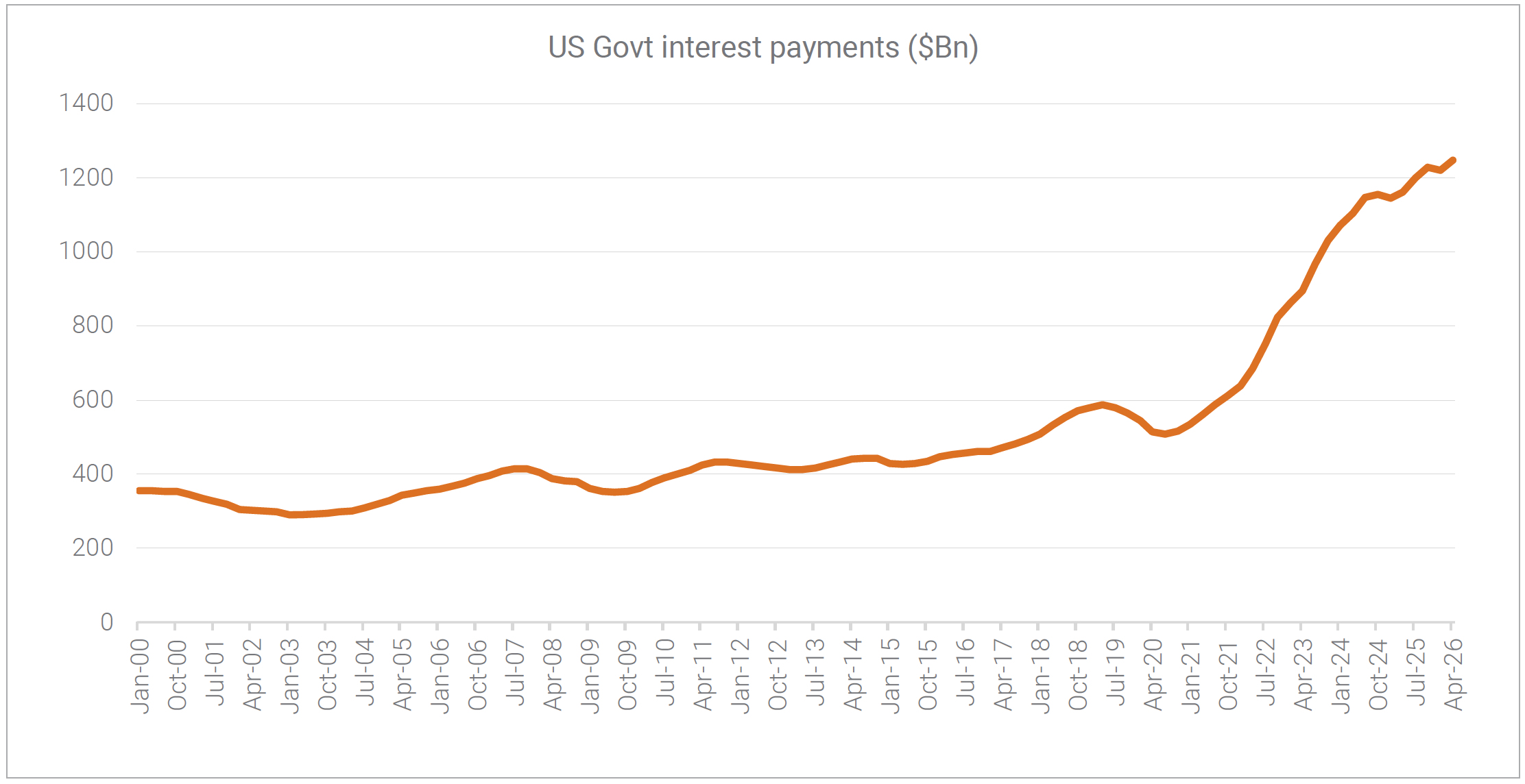
- a central bank that seems unaware that by raising interest rates, they are also pump-priming the economy by the interest income channel on government debt which is now approaching US$1.3 trillion per annum and trending toward US$2 trillion per annum (at +5% bond yields);
- a massive (some estimate US$5–71 trillion) build-out of non-interest rate sensitive AI infrastructure including data centres, energy, and associated networking and services making huge claim on real economic resources; and
- an ongoing energy crisis from various global conflicts, potentially leading to a food crisis.
 Source: US Treasury, Quay Global.
As always, the next big move down in long-term bond yields will be driven by a material change in expectations relating to central bank policy. That may include some type of credit crisis, a collapse in the AI infrastructure boom, or widespread company bankruptcies.
Of course, these events are almost impossible to predict, which is why many wealth protection strategies employ bonds or bond-like assets in portfolios, because, in our view, one day the equity cycle will turn, expectations around central bank actions will change, and bonds will have their day again – even while US debt approaches US$50 trillion.
The content contained in this article represents the opinions of the authors. The authors may hold either long or short positions in securities of various companies discussed in the article. The commentary in this article in no way constitutes a solicitation of business or investment advice. It is intended solely as an avenue for the authors to express their personal views on investing and for the entertainment of the reader.
[1] https://www.mckinsey.com/industries/technology-media-and-telecommunications/our-insights/the-cost-of-compute-a-7-trillion-dollar-race-to-scale-data-centers