

Demand has surged, and most forecast it to continue
Spending by the largest cloud and AI providers has grown sharply since 2022 and continues at pace. The five largest companies in the space, or ‘hyperscalers’ – Amazon, Microsoft, Alphabet, Meta and Oracle – are expected to spend in the order of US$700 billion on capital projects in 2026, up around 70 per cent on 2025 and more than four times 2022 levels. Roughly three-quarters of this spend relates to data centres: self-builds, leasing from third-party operators, and sourcing servers and chips.
There has been genuine debate about how durable this appetite for capital expenditure will prove. Alphabet’s June 2026 equity raise of ~US$85 billion to fund AI infrastructure (the largest equity offering in history, in fact larger than the SpaceX IPO) suggests the major players remain fully committed, at least in the near term. That said, a commitment to spend is not the same as a return on that spend, and the eventual payback remains unproven.
A boon for data centre REITs
While the data centre build-out is being driven by hyperscaler demand, what’s less understood is that specialist listed data centre managers have operated successfully for years prior to the current boom and, not surprisingly, incumbent data centre REITs have performed very well in recent times.
The wave of fresh capital has clearly flowed through to leasing activity. Global data centre REIT leasing volumes have grown substantially since 2022, with activity concentrated in the US. Records were smashed in the first quarter of 2026, with 4,000 megawatts leased in Q1 2026 versus 1,300 megawatts for the whole of calendar 2021.
The scale of demand has absorbed almost all available capacity in major markets: US primary market vacancies have fallen to around one per cent, and the Northern Virginia submarket – the world’s largest – sits near half a per cent.
With power constraints serving as a bottleneck to bringing new data centres on line (grid-connection wait times average around five years in the US and Europe, and close to three years in Asia-Pacific) this has delivered substantial pricing power to existing data centre operators, driving strong rent growth. This upper hand marks a change from the pre-2022 period when tenants set the terms.
 Source: CBRE
This combination of rising rents and a powerful structural tailwind has produced strong returns for investors in listed data centre REITs. Since the public release of ChatGPT in November 2022, Equinix and Digital Realty, the two largest data centre REITs globally, delivered total returns of approximately 104 per cent and 114 per cent respectively*.
Cranking up the development
Hyperscaler capital has also flowed to developers. Data centre development projects today are being underwritten at stabilised yields on cost of roughly 10–13 per cent, drawing in a wide range of entrants including repositioned industrial REITs (think Goodman Group), former crypto miners (think IREN and Firmus), and more speculative developers.
Around 31.7GW of new data centre capacity is currently under construction globally, with 25.3GW of that in the Americas, predominantly the US. To put that in context, it represents close to 30 per cent of existing global stock, or more than US$380 billion of construction spend on our estimates. Looking further out, global data centre capacity is expected to roughly double between 2025 and 2030, from about 103GW to around 200GW – a compound annual growth rate of around 14 per cent.
A new source of risk: community and policy pushback
An emerging risk is growing resistance to new data centre development, driven by concerns about effects on local utility prices, environmental impact and broader ‘not in my backyard’ sentiment. As shown below, in the US this is no longer a fringe issue.
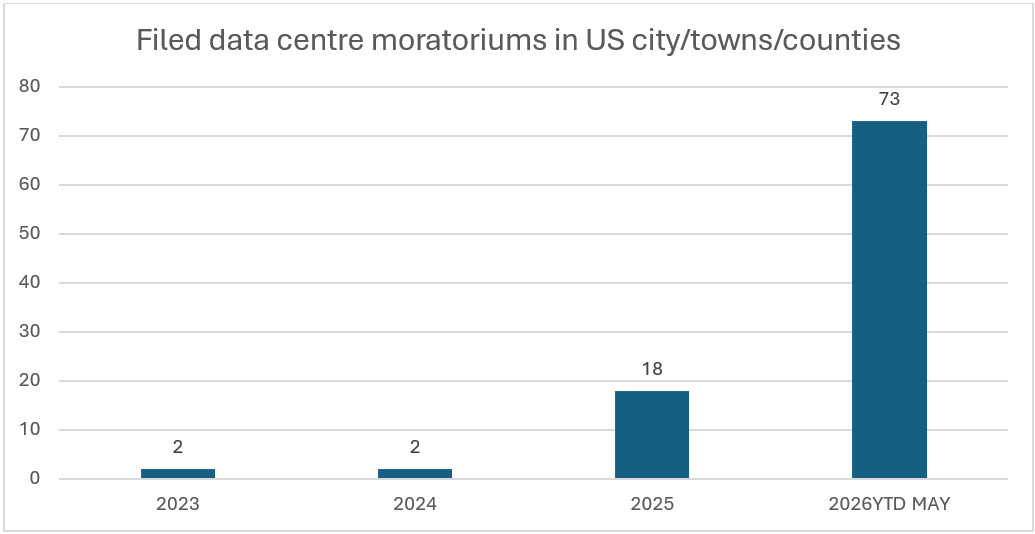 As at 18 May 2026. Source: Interconnected Capital
A recent local example of this constraint is Australian operator DigiCo (ASX:DGT), who abandoned a planned development in Los Angeles after council and community opposition. In DigiCo’s prospectus the project had been slated to begin construction in 2025; when the project was cancelled in April 2026, a development permit had not even been granted.
In our view, this kind of pushback is a growing risk for newer and smaller operators, where the market has awarded a high valuation on the assumption that sizeable development pipelines will be completed and leased on schedule.
What we anchor to
Price is always the ballast against a compelling growth narrative, and on most measures the listed data centre cohort is fully priced. A high degree of development execution is arguably built into current valuations, which leaves little room for disappointment if developers can’t deliver, demand stutters, supply overshoots, or policy friction increases.
Our deep experience investing across property sectors globally tells us to retain a clear-eyed read on where supply and demand dynamics can shift. It is unusual to see this much new supply scheduled for a single sector in such a short window. While the demand profile gets most commentator attention, there are nuanced and emerging risks on the supply side, including adaptation risk as chip technology rapidly evolves, input cost (eg power price) risk and even stranded asset risk.
We view property developers within any property sector with extreme caution, with the starting principle that if it’s not earning rent, risks are higher. The same risks are on full display for listed data centre operators with large development pipelines. Coupled with full valuations and a dynamic operating environment, we believe caution is required.
How data centres stack up in the property universe
The principles above equate to data centre REITs making up only a modest part of our portfolios, and why the sector is a smaller share of our holdings than its approximate 11 per cent weight in the global REIT index. That positioning is not a bet against the theme. It reflects our view that, at today’s prices, we can find more attractive risk-adjusted opportunities elsewhere in global real estate, where growth is less fully appreciated and the margin of safety is wider. Examples of these include senior housing and retail in the US – all sectors experiencing fundamental undersupply leading to significant rent and earnings growth.
Our preference within the data centre universes is for operators with large, established, US-centred portfolios that are already generating income, bought at the most reasonable valuation we can find. Our core data centre holding, Digital Realty (NYSE:DLR), illustrates this: DLR operates more than 300 data centres (over 100 in the US) and trades on an EBITDA multiple of around 21 times, against relatively small local names such as DigiCo (around 22 times) and NextDC (around 49 times). We also believe incumbents with large, already-operating US portfolios will be well positioned should there be further delays in new supply.
In summary
Data centre REITs have, to this point, wholly benefitted from the AI pile-on. To us, the sector in aggregate appeals given the demand-supply imbalance, but where we believe careful stock selection is required, is with listed data centre operators with large development pipeline execution risk – a substantial risk that exists for all players – and the full (if not stretched) pricing for the sector.
We do not think the answer is to avoid the sector, nor to chase it. We think it is to be selective – to favour quality and existing cash flow over promise, to insist on a sensible entry price, and to keep the sector in proportion to other opportunities across the listed real estate universe. In a part of the market priced close to perfection, discipline is what protects investors when the story meets reality.
*Total shareholder returns in USD for NYSE:DLR and NYSE:EQIX from 30 November 2022 to 31 May 2026.